What Did OpenAI’s AI Model Actually Solve?
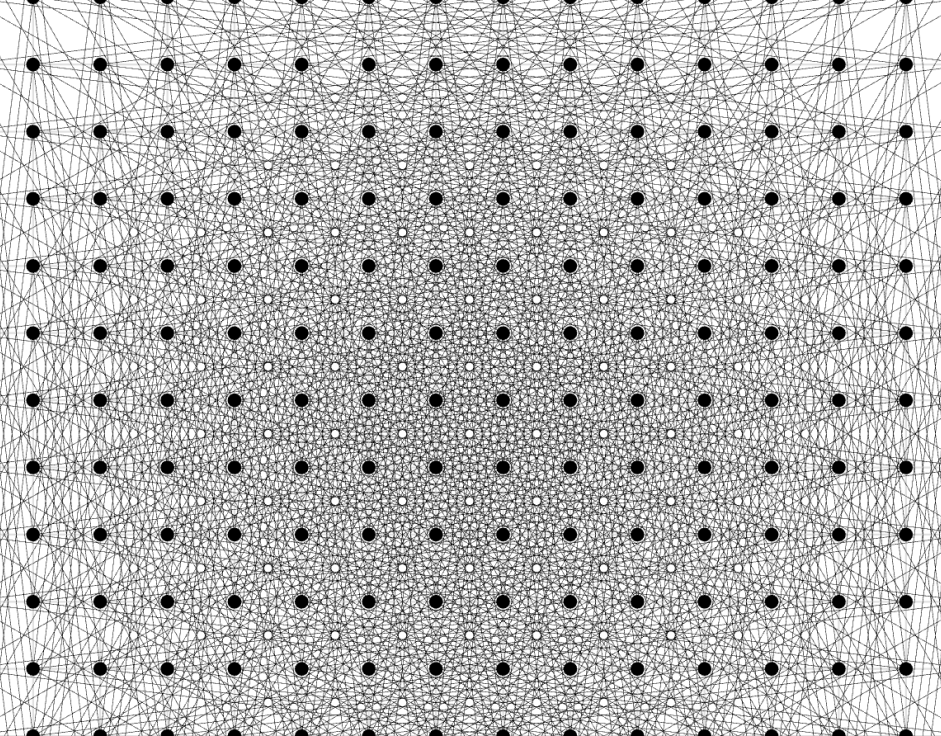
The planar unit distance problem asks a deceptively simple question: if you place N points in a plane, what’s the maximum number of pairs that can be exactly one unit apart? For nearly 80 years, mathematicians believed the best arrangements looked roughly like square grids, producing only slightly more than a linear number of unit-distance pairs. OpenAI’s model disproved this belief, discovering an infinite family of configurations that yield a polynomial improvement over what was thought possible.
How Did the Model Arrive at the Proof?
The proof came from a new general-purpose reasoning model, not a system specifically designed for mathematics, theorem proving, or the unit distance problem. What makes the result particularly striking is that the model connected insights from algebraic number theory — a very different branch of mathematics — to the geometric question at hand. The proof uses sophisticated concepts including infinite class field towers and Golod-Shafarevich theory to construct configurations that exceed previously assumed limits.
How Did Mathematicians Verify the Result?
OpenAI published the proof alongside companion remarks from external mathematicians including Noga Alon, Tim Gowers, Thomas Bloom, Daniel Litt, Will Sawin, and Melanie Matchett Wood. Gowers wrote that the solution is “a milestone in AI mathematics” and that if a human had submitted the paper to the Annals of Mathematics, he “would have recommended acceptance without any hesitation.” Princeton mathematician Will Sawin said his “immediate reaction was disbelief” before becoming convinced the proof works.
Why This Matters for AI Research
The result provides one of the strongest public demonstrations yet that AI models can contribute to original research rather than merely summarizing existing knowledge. OpenAI has spent the past year arguing that reasoning models can spend more computation working through difficult tasks, and this is a much sharper test than solving contest-style questions with known answers. The company’s researchers have noted the model wasn’t trained with the goal of doing math research.