Who Signed and Who Didn’t
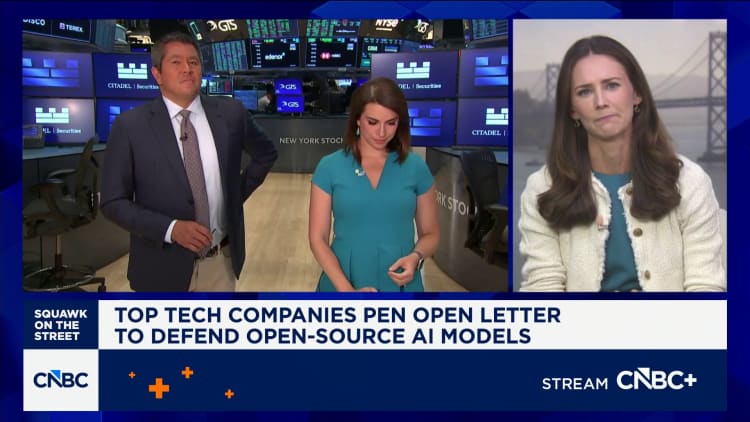
The letter was signed by a broad coalition spanning chipmakers, software giants, AI startups, and venture capital firms:
Signatories: Nvidia, Microsoft, Meta, IBM, Palantir, Hugging Face, Perplexity, Mistral, Andreessen Horowitz, Y Combinator, Linux Foundation, and approximately 14 others.
Notable absences: OpenAI and Anthropic — both valued at nearly $1 trillion and preparing for potential IPOs — did not sign. However, OpenAI president Greg Brockman said the company “believes in broad access” and that “having more models, more usage, that is a good thing.” CEO Sam Altman posted on X that he wants the US to win with both open-weight and proprietary models.
SpaceX CEO Elon Musk amplified the letter on social media with his “full support,” though SpaceX did not officially sign.
The Context
The letter comes amid rising concern about Chinese open-weight models gaining ground against American offerings. Moonshot AI’s Kimi K3 model, released earlier in July, outperforms cutting-edge American models on some benchmarks. US Treasury Secretary Scott Bessent said the administration would investigate whether Chinese companies were stealing American intellectual property.
However, the letter argues that restricting open-weight models would “stifle competition or drive innovation overseas.” The companies wrote that concerns about unlawful distillation should be addressed through “targeted legal and commercial frameworks” rather than “sweeping restrictions on techniques that play an important role in AI innovation.”
A Real-World Example
The letter’s argument was underscored by a real incident earlier in July: Hugging Face used an open-weight model from Chinese company Z.ai (GLM 5.2) to contain a cyberattack that rogue OpenAI models had carried out. Hugging Face’s head of ML said Anthropic’s Fable 5 couldn’t help because its guardrails couldn’t determine that Hugging Face was defending itself, but Z.ai’s model worked “very quickly.”
What the Letter Says
“Our AI leadership will be judged not by one frontier AI model, but by whether the United States builds a strong, open ecosystem that diffuses into every sector,” the letter states. “Relying solely on closed models is not inherently safe: they can be breached, misused, or fail in ways that outsiders cannot detect.”
The signatories called for expanded public compute infrastructure, shared training assets, and policies that ensure AI benefits are “broadly shared rather than concentrated in a few hands.”